Map, Compass & GPS

Map, Compass & GPS
Wild flowers along Fall Creek on the way to the Green Lakes - Oregon

Friday, January 31, 2014

Winter Survival Kit For Your Vehicle

After watching the mess in Atlanta, I thought Leon's post and video was most timely.


Travel can be very dangerous this time of year. Black ice, slippery pavement, high winds and blowing snow, or reduced visibility due to fog, rain and snow storms can all happen within a few miles. It doesn’t matter if you live in the Oregon high desert or the frigid
Click here to buy survival kits
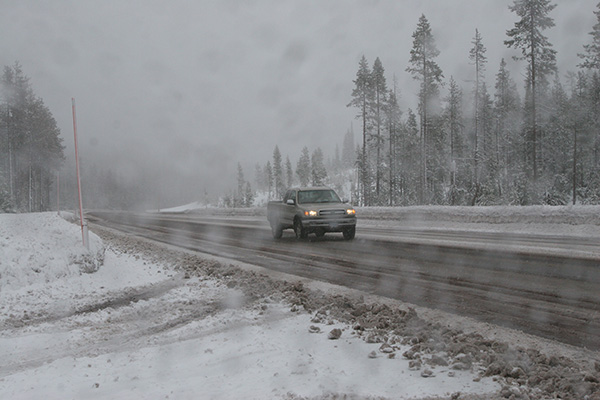
A survival kit for your car can be indispensable when the weather turns bad.
Midwest. If  your car slips off the road in an isolated area, during a blizzard, a routine drive to visit the family can turn into a nightmare.
by Leon Pantenburg
Nationwide attention was brought to winter survival in a stalled vehicle in 2006.
In December, Californian James Kim, 35, died in Oregon’s Rogue River Wilderness after leaving his wife and children to get help. The family car was stuck in snow on a remote road for several days.
Mr. Kim departed from the car, he  left the road and apparently got lost in the deep snow. He bushwhacked five miles down steep canyons, covering about eight miles through rough country, but ending up only about a mile as the crow flies from his car. Mr Kim’s body was found several days later, and he had apparently died of  hypothermia His family was found alive in their car a few days later. (To view the complete story, click on Kim Tragedy video)
To watch Leon's video and read the rest of the post go here.

Thursday, January 30, 2014

Backpacks - Internal vs. External Frame

The information below is from the Swiss Army website.  Of course they want to sell you their pack but they do offer a nice explanation of the options available to the hiker.


Internal or external frame backpacks- When considering purchasing backpacks. There are some differences that you need to know about.
For example, for hiking trips that last 2 days or more. You should look at the internal or  external frame backpacks.
Here I will explain the subtle differences between internal or external frame backpacks.
To read the rest of the post go here.

Sunday, January 26, 2014

Cleaning Your CamelBak Reservoir

Keeping your CamelBak hydration system clean is a must.  Section Hiker has a great post on the process.


If you use a Camelbak Hydration Reservoir you’re going to want to keep it, its hose , and bite valve clean. If you just drink water, you can store it empty in the freezer or dry it out after each use and nothing bad will grow in it. But if you put any kind of flavoring or performance enhancement powder into your Camelbak, you definitely need to take a more active approach to keeping them clean between uses. These things can turn into science experiments quickly if you’re not careful.


To read the complete post go here.

As an aside, to air dry my reservoir I use the brown cardboard roller from a old roll of paper towels.  The roller keeps the body/sides apart allowing for better air drying.

Saturday, January 25, 2014

Danger Using Gasoline


The following article is from the Bend Bulletin newspaper.  Four injured in an explosion that could have been prevented.
An explosion in the backyard of a Sisters home reportedly injured four people Saturday evening.
The blast, in the 300 block of West Oak Avenue, was reported shortly after 6 p.m. Four people at the home were burned, three of whom were transported by helicopter to St. Charles Bend for treatment.
Sgt. Ty Rupert, of the Deschutes County Sherriff’s Office, said two or three of the injured have been or will be taken to the Oregon Burn Center at Legacy Emanuel Medical Center in Portland for further treatment
Rupert said it appears the injured people had lit a fire in a backyard fire pit and attempted to revive their dying fire by putting gasoline on it.

One of the injured has died from burns.

Can gasoline be used to start a fire?  Is there a safe way; sure....but not this way.  More on this later.

Friday, January 24, 2014

The Universal Transverse Mercator Grid System

Philip Werner of www.sectionhiker.com invited me to write a navigation post for his readers.

To read my post go here .

Thursday, January 23, 2014

Calibrating a GPS' Electronic Compass

Check out my latest post with www.seattlebackpackersmagazine.com about calibrating your  GPS receiver's electronic compass.

To read the complete post go here.

Wednesday, January 22, 2014

Navigation With The North Star


The North Star is a beacon that we can use to guide us in the backcountry.
Few hikers use the celestial bodies in the night sky to navigate by.  But on a clear night, the night sky provides a feature that is an excellent source of direction.  It doesn’t matter if it is June or November, if you are in Wyoming or Oregon.
The North Star or Polaris is the principle star that I will focus on. 
For the backcountry hiker consider that Polaris is fixed in position over the northern pole.  Unique from other celestial stars and planets, Polaris is very closely aligned to the earth’s axis.  Stars and planets rotate around Polaris.  And like the sun, this rotation is from east to west through the sky.  Polaris will be found approximately half way between the northern horizon and straight overhead.  In the northern hemisphere, Polaris can found in our northern sky and is never more 1° from true north – the North Pole. 
Constellations help locate Polaris.  Cassiopeia and the Big Dipper point to Polaris.  Uniquely, Cassiopeia, the Big Dipper and Little Dipper can be seen in relation to Polaris year round.  In winter, the constellation of Orion will also help locate Polaris.

To read the rest of the post go here.